Product Development
& Formulation R&D
We take new product ideas from a blank page to a commercially ready, ASTM-validated, certification-ready lubricant or grease — using your raw materials, your specification targets, and your manufacturing constraints. Every product developed becomes yours entirely. No licences, no royalties, no dependency.
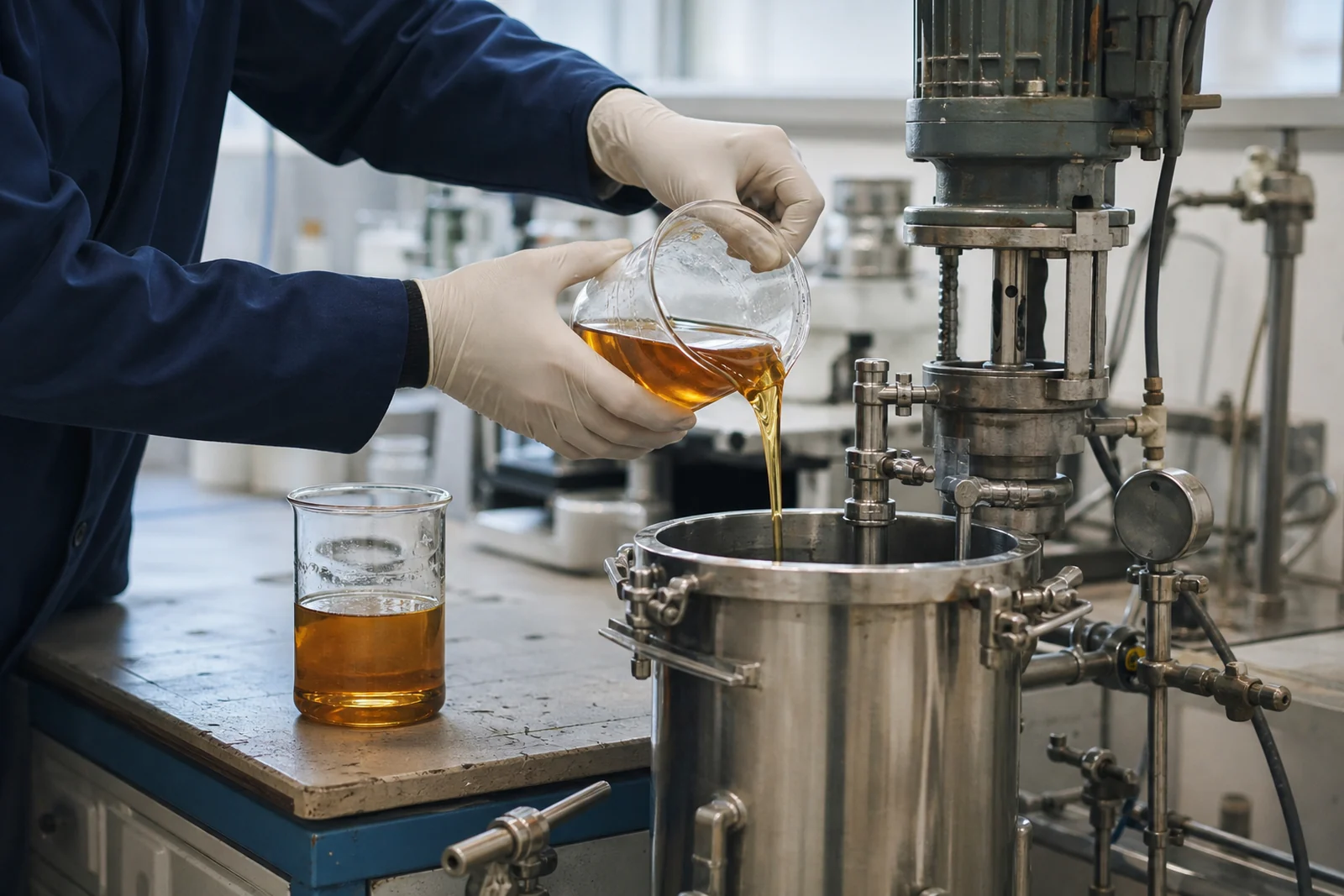
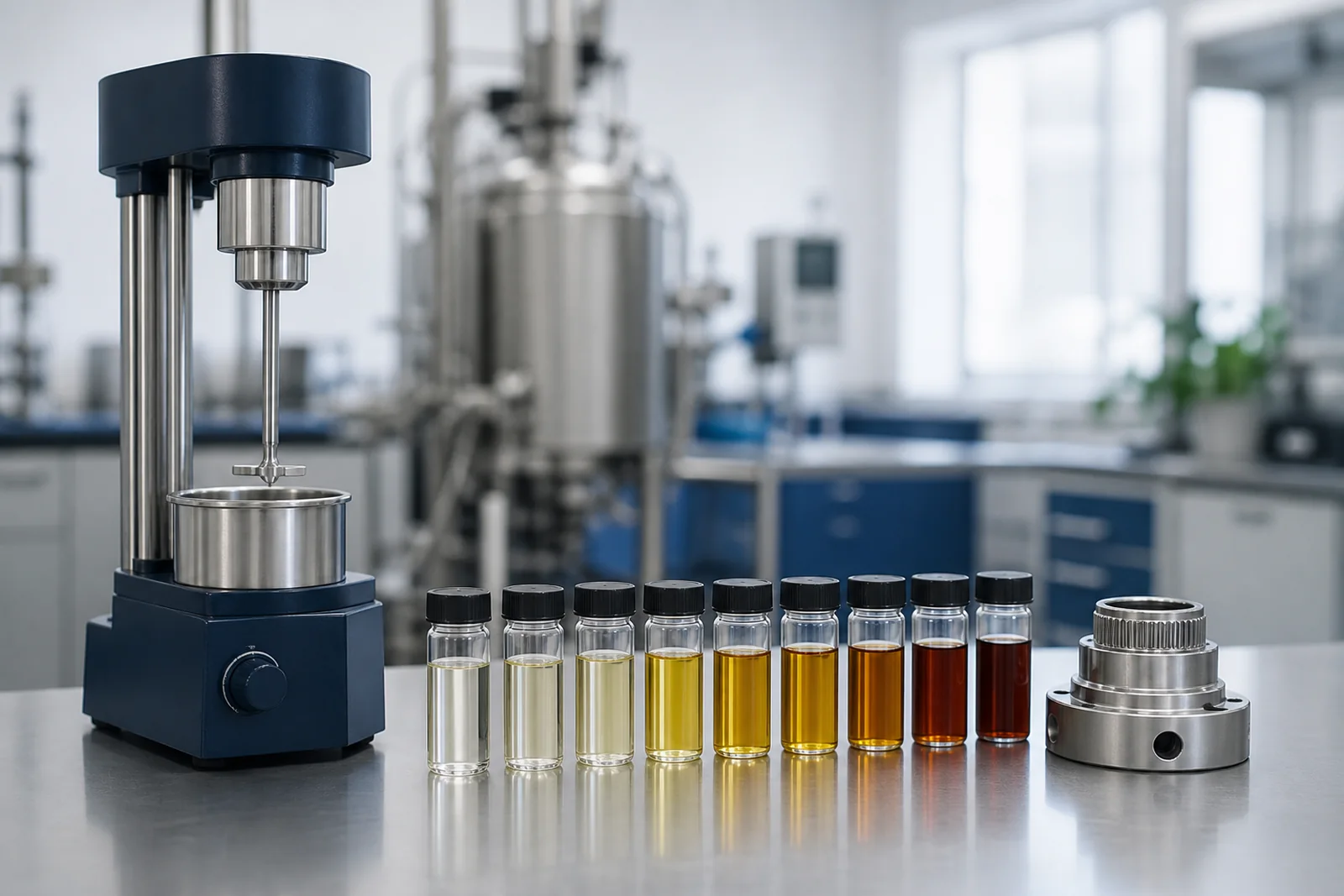
- 01Define the product
- 02Iterate and validate
- 03Scale with control
We are not a laboratory service that runs your samples.
We are the chemist who designs your product — from first principles, through every test failure, to the final formulation that ships.
Most independent lubricant manufacturers — across India, the Middle East, Africa, Asia, Europe and beyond — have no in-house formulation chemist. They rely on additive supplier recommendations — which means buying what the supplier wants to sell, at the margin the supplier sets. Lubechem changes that equation.
Six Categories of
Products We Develop
Every product in the lubricant and specialty chemical space — from novel thickener chemistry to bio-derived base fluids to custom additive packages.
- Calcium sulfonate complex — extreme performance without EP additives
- Polyurea — high-speed electric motor and high-temperature applications
- Bentone / clay — extreme high-temperature (>200°C), no drop point
- Bio-based grease from fatty acid waste streams (vegetable oil, biodiesel plant)
- NSF H1 food-grade grease with full USDA/NSF approved raw materials
- NLGI 000–6 full grade range development for any thickener type
- EAL (Environmentally Acceptable Lubricants) — HETG/HEES/HEPG/HEPR categories
- Wire rope lubricant — high-viscosity penetrating fluid with corrosion protection
- Compressor oil — polyol ester base for refrigeration (HFC/HFO compatible)
- Transformer oil — IEC 60296 Class I and II, inhibited and uninhibited
- Slideway oil — stick-slip resistant formulation for machine tool guideways
- Total loss lubricant — chain oil, saw chain, form oil, concrete mould release
- FAME-based biodegradable hydraulic oil (ISO 15380 HETG, HEES)
- Castor oil derivative lubricants — estolides, sulfurised castor EP additive
- High oleic sunflower oil base lubricant — high VI, good oxidation stability
- Used cooking oil (UCO) valorisation into lubricant products
- Fatty acid distillate from biodiesel plants → grease thickener raw material
- OECD 301B biodegradability testing coordination included
- Engine oil additive package — ZDDP, overbased detergents, PIBSI dispersant, OCP VII
- Gear oil additive package — GL-4, GL-5, MT-1 performance levels
- Hydraulic oil package — AW, R&O, HM, HV performance levels
- Grease additive system — EP, AO, rust inhibitor, corrosion inhibitor selection
- Industrial gear oil — CLP, CLPE, CKC performance levels
- Source: local & global additive distributors — supply chain independence from import
- Full engine oil range — petrol (API SP) + diesel HD (API CK-4) + ACEA
- Industrial product range — gear, hydraulic, compressor, turbine, circulation
- Automotive product range — ATF, gear oil, brake fluid compatibility review
- Export market range — Middle East, Africa, Southeast Asia certification
- Private label OEM supply — formulation matched to OEM approved specifications
- Complete TDS, SDS, label copy, product catalogue content prepared
- Rust preventive oils — thin-film (VCI compatible), film-forming, water-displacing
- Soluble cutting oil concentrate — emulsifiable for machining, low-foam
- Neat cutting oil — sulfurised, heavy-duty tapping and threading
- Heat transfer oil — synthetic and mineral-based, high-flash, low-fouling
- Drawing and stamping compounds — metalforming lubrication, ferrous and non-ferrous
- Quench oil — controlled cooling rate for steel heat treatment
How We Take a Product
From Concept to Commercial
Every engagement follows the same disciplined framework — the same approach used by leading contract research and product development organisations across pharma, materials, and speciality chemicals. Adapted for the lubricant industry.
Problem Definition
Feasibility Analysis
Prototype
Testing & Optimisation
& Transfer
- Runs your samples — you design the formula✗
- Reports results — you decide what to change✗
- Charges per test run — reformulation is extra✗
- No manufacturing SOP✗
- No certification support✗
- We design the formula from first principles✓
- We interpret results and make reformulation decisions✓
- Reformulation cycles included in project scope✓
- Full manufacturing SOP delivered with product✓
- Certification documentation prepared and submitted✓
Your Formula.
Your Secret.
Your Business.
Formulation knowledge is a competitive moat. We understand this completely. Every engagement is structured to protect your information and transfer everything we develop entirely to you.
Three Ways to
Work with Us
We structure engagements based on what the project needs — not on a standard billing model. Choose the structure that fits your situation.
- Fixed scope: one product to a defined specification
- All reformulation iterations included
- ASTM testing coordinated through NABL labs
- Full SOP + IP transfer on completion
- BIS or API certification documentation
- Multiple products in a coordinated development programme
- Shared raw material infrastructure design (reduces SKUs)
- All ASTM testing coordinated concurrently where possible
- Full TDS, SDS, product catalogue content for all products
- API/ACEA/BIS certification for all products in the range
- Manufacturing integration advice for blending or reactor setup
- Fixed monthly retainer — not per-project billing
- New product development throughout the year
- Formulation troubleshooting included
- Additive cost optimisation reviews
- Regulatory update monitoring and action
- Technical support for sales and customer queries
Applications Across
Every Industrial Sector
The end-use sector determines what the product must do in the field — and therefore which formulation chemistry is appropriate. We have developed products for all of these sectors.
A biodiesel manufacturer in Tamil Nadu was producing methyl esters (FAME) from a mixed feedstock of jatropha, palm, and used cooking oil. Their transesterification process generated two by-product streams being sold at commodity prices: a crude glycerine stream and a fatty acid distillate — primarily a mixture of palmitic acid (C16:0), stearic acid (C18:0), oleic acid (C18:1), and 12-hydroxystearic acid (12-HSA) fractions. The client asked: could these fatty acid streams be used to make grease instead?
We conducted a two-day site visit — inspecting the biodiesel plant, characterising the fatty acid by-product streams by GC analysis, assessing batch-to-batch variability, and evaluating existing equipment for grease saponification compatibility. The key challenge identified on site: the 12-HSA fraction content varied between 18–34% across production batches, depending on the feedstock blend. Stable grease production from this variable raw material required a formulation strategy that was robust across the full 12-HSA composition range.
We designed a calcium borate complexing system — using the calcium borate complex as a structural backbone independent of 12-HSA content, with the fatty acid contribution providing lubricity and surface affinity rather than being the sole thickener structure. This made the formulation tolerant of batch-to-batch fatty acid composition variation. The EP additive chosen was sulfurised castor oil — itself bio-derived — which added green chemistry credentials to the product.
The finished product exceeded BIS IS 7623 specification requirements, achieved >272°C drop point (confirmed by D2265), passed four-ball EP testing at 280 kgf weld point, and contained >60% bio-based content by weight. The client's fatty acid by-product, previously sold at ₹18–22/kg (~US$0.21–0.26/kg) to soap manufacturers, now generates ₹95–120/kg (~US$1.12–1.42/kg) equivalent value as a high-performance industrial grease raw material.
- Variable 12-HSA content (18–34%) in feedstock — formulation designed to be robust across full range
- Crude glycerine contamination in fatty acid stream — pre-treatment washing protocol designed
- Limited mixing equipment on-site — saponification SOP designed for existing heated vessel without dedicated grease reactor
- Absence of Group I base oil in Tamil Nadu — Group II sourcing from Chennai-area supplier established
- Oxidation stability with unsaturated fatty acid content — hindered phenolic antioxidant system selected and dose optimised by D942 TOST
Other Development
Engagements
Feedstocks We Have Worked With
& Products Developed From Them
Converting industrial by-products and bio-derived materials into high-value lubricant products. The raw material is often already available at low or zero cost — the value comes from formulation chemistry.
| Feedstock | Source Industry | Product Developed | Key Technical Consideration |
|---|---|---|---|
| Fatty Acid & Triglyceride Feedstocks | |||
| Fatty acid distillate from biodiesel plant | Biodiesel / oleochemical | High drop point calcium complex grease (IS 7623) | 12-HSA content variable — formulation designed to be robust across 18–34% 12-HSA range using borate complexing backbone |
| Jatropha FAME (biodiesel methyl ester) | Jatropha oil processor | ISO 15380 HETG biodegradable hydraulic oil HV 46 | Higher polyunsaturate content than rapeseed FAME — requires elevated ADPA + hindered phenolic antioxidant treat rate. OECD 301B >65% |
| Used cooking oil (UCO) | Restaurant, food processing | HETG hydraulic oil base after transesterification to FAME | Mixed fatty acid composition (palmitic, linoleic, oleic) — oxidation stability less predictable than pure crop FAME. Higher antioxidant dose required |
| High oleic sunflower oil | Agricultural oilseed processing | Biodegradable gear lubricant and chain oil | High VI (~200), good natural oxidation stability. Requires pour point depressant for cold climate use. Lower cost than rapeseed in West India |
| Castor oil | Castor crop / oleochemical | Sulfurised castor EP additive, estolide base oil, brake fluid base | Ricinoleic acid (C18:1-OH) is the functional component. Sulfurisation creates EP agent. Estolide synthesis requires acid catalyst and temperature control |
| Industrial By-Product Feedstocks | |||
| Crude glycerine (biodiesel by-product) | Biodiesel plant | Not directly — purification to pharma grade glycerine advised; lubricant use not viable with high methanol/soap contamination | Glycerine contamination of grease causes severe hydrolysis instability. Not recommended as lubricant ingredient without very high purity (>99.5%) |
| Still bottom from solvent refinery | Chemical / solvent manufacturing | High-viscosity process oil, rubber extender oil | Variable composition — needs GC-MS characterisation before formulation. Aromatic content determines suitability. Flash point must be verified lot by lot |
| Spent bleaching earth (oil refining) | Edible oil refinery | Not suitable for lubricant formulation — contaminated clay only | Contains 20–30% residual oil but heavily contaminated with phospholipids, soaps, oxidation products. Disposal issue, not a lubricant feedstock |
| Synthetic & Reclaimed Feedstocks | |||
| Re-refined base oil (RRBO) | Used oil collection and re-refining | Industrial gear oil, hydraulic oil, lower-grade engine oil | RRBO quality varies significantly by source. Requires rigorous incoming QC (D445, D92, D97, D2272) before formulation. Suitable for API SL and below, typically not SP |
| Polyalkylene glycol (PAG) from industrial waste | Textile, chemical industry effluent | Not viable — purity requirements for lubricant PAG are very high | Reclaimed PAG has undefined MW distribution and contamination profile. Not recommended without full characterisation at certified lab |
If It Involves Chemistry,
We Can Develop It.
Our product development capability is not limited to lubricants and greases. Any specialty chemical product that requires formulation chemistry — we develop it. A client comes to us with a performance requirement, a problem they need solved, or a market gap they want to fill. We translate that into a product formulation, test it, scale it, and hand it over.
The product categories below span everything we have developed or have the direct capability to develop. Most began with exactly the same conversation: "We need a product that does X. Can you make it?"
The answer is almost always: yes. The question that follows is always the right one — what exactly must it do, under what conditions, and what must it not do. Define the problem precisely. We develop the solution.
The Problem Defines
The Chemistry
Every product we develop starts with a use-case — not a formulation type. The railway wheel press-fit compound is one of the clearest examples of how application requirements drive entirely novel chemistry — it sits within our broader railway lubricant formulation work.
This product sits at the intersection of lubricant chemistry, adhesive chemistry, and polymer science. No off-the-shelf product addressed this exact requirement. The formulation was developed from first principles — anaerobic cure mechanism, lubricant additive selection, open-time control — and validated to Indian Railways' wheel press specification. This is what product development means: the application defines the chemistry, not the other way around.
Antifoam & Defoamer
Development
One of our most consistently requested specialty chemical development areas. We have developed antifoam formulations for over a dozen industries — each with different chemistry, incompatibility constraints, and regulatory requirements. Not one of them could use a standard off-the-shelf antifoam product.
We Can Analyse Any Product
And Develop an Equivalent
A competitor product is outperforming yours and you don't know why. An imported product is too expensive and you want a cost-competitive locally manufactured alternative. An approved product is being discontinued and you need a drop-in replacement. These are reverse engineering problems — and we solve them.
Every Category of Specialty
Chemical Product We Develop
If it is formulated from chemistry and serves an industrial or commercial function — we can develop it. This is not a theoretical list. Every category below has been developed or is within our direct formulation capability.
Describe what it must do.
We will tell you if we can build it.
In 15 years of formulation work, we have rarely encountered a requirement that was not achievable with the right chemistry. The answer to "can you make X?" is almost always yes — the real question is what performance, at what cost, on what timeline.
Describe Your Product RequirementFrequently Asked
Questions
It depends on the product type and how many ASTM tests are required. Simple products with few tests (a rust preventive oil, a plain mineral gear oil) can be completed in 6–8 weeks. Complex products requiring multiple ASTM methods, enzyme compatibility, or biodegradability testing typically take 12–20 weeks. Bio-based products with site visits and feedstock characterisation add 2–3 weeks at the start. We give you a realistic timeline in the initial assessment — we do not give optimistic estimates to win the project.
Test failures are expected — every formulation development project involves them. When a test fails, we interpret the result, identify the formulation variable responsible, modify the formulation, and submit for retesting. This cycle is included in the project scope. We do not charge per reformulation iteration. The project is scoped to completion — to a product that passes all required tests — not to a number of attempts.
In practice, most of our formulations reach specification within 2–3 test cycles because the reformulation decisions are based on understanding why the test failed, not on guessing what to change.
Yes — this is a significant part of our R&D work. The first step is always feedstock characterisation — we need to understand the composition, batch-to-batch variability, contamination profile, and available volume before we can determine what products are technically feasible. For fatty acid streams, vegetable oil derivatives, and bio-based materials, we typically conduct a site visit to characterise the material in its production context. We will give you an honest assessment of what is and isn't viable from your feedstock before any development work begins.
Only what is relevant to the formulation work. We need to know the general type of raw materials available to you (which base oil groups, which additive distributors you use) so we can design a formulation from materials you can actually source. We do not need your commercial terms with suppliers, your margins, or your customer list. Everything you share is covered by the NDA signed before any disclosure.
Absolutely. This is often faster and cheaper than starting from scratch. Share the failing test result, the current formulation (if you're comfortable disclosing it under NDA), and we will identify what needs to change. Sometimes the fix is simple — a treat rate adjustment, a PPD type switch, an antioxidant addition — and can be done in one or two test cycles. If the formulation has a more fundamental chemistry problem, we'll tell you honestly whether incremental fixes are viable or whether a redesign would be more efficient.
Yes. A single product development engagement is our most common project type. We have developed single products for clients ranging from a 500 L/month start-up blender to an established manufacturer adding one new SKU to their existing range. The engagement is scoped to the work required — not to a minimum billing size. Tell us what you need and we'll tell you what's involved.