Grease Formulation
All Thickener Types
The most technically demanding area of lubricant chemistry — and our deepest specialisation since 2010. We formulate across every thickener system: soap-based (calcium, lithium, sodium, barium, aluminium), complex soaps (LiX, CaX, AlX, calcium sulfonate complex), non-soap (polyurea, bentone, silica, PTFE), and specialty types. Every formulation includes the complete manufacturing SOP — the process documentation is as critical as the formula itself. It sits alongside our wider lubricant oil formulation consultant practice for fluid lubricants.
- 01Thickener system
- 02Operating condition
- 03Process and test control
All Consistency Grades
We Formulate
ASTM D217 worked penetration (60 strokes) × 0.1mm
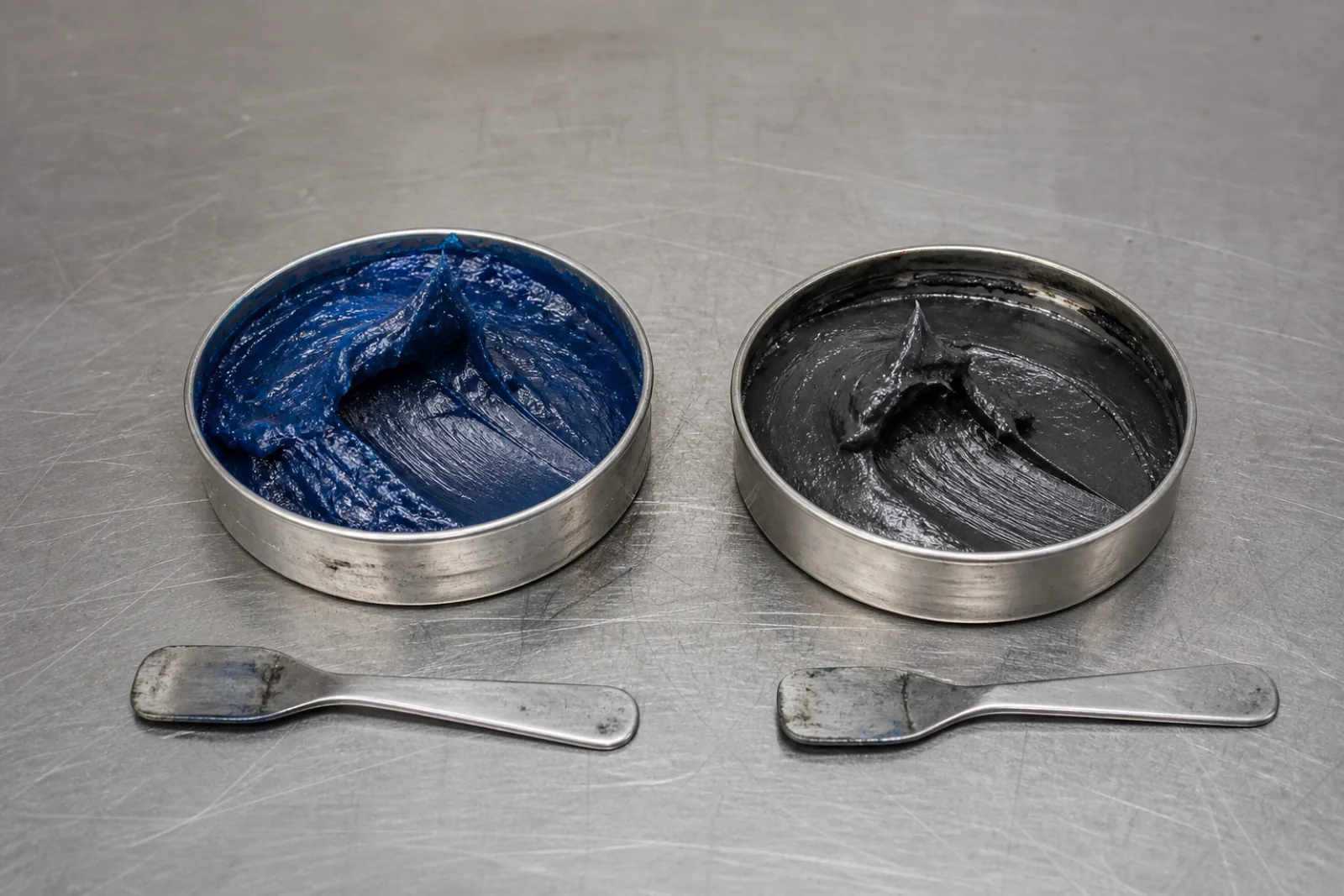
Blue lithium-complex and graphite-grey moly grease can both be NLGI 2. The grade describes consistency; thickener chemistry, base oil and additives determine performance.
Every Grease Type
We Formulate
| Grease Type | Thickener System | Drop Point | Temp Range | Properties, Applications & Notes |
|---|---|---|---|---|
| A · CALCIUM SOAP GREASES | ||||
| Anhydrous Calcium Grease | Ca-soap (12-HSA) | ~100°C | –20°C to 80°C | Excellent water resistance, smooth buttery texture, non-melt — stays in place near water. Low cost. Used in chassis lubrication, agricultural equipment, water-contact slow-speed bearings. Cannot be used above 80°C (drops at ~100°C). |
| Hydrated Calcium Grease | Ca-soap (stearic) | <80°C | –10°C to 60°C | Contains ~1–3% water as structural stabiliser. Very soft, pumpable. Low-cost chassis, wheel bearings on slow vehicles. Being replaced by lithium grades in most applications but still widely used in India and other price-sensitive markets for very low-cost applications. |
| Calcium Cup Grease | Ca-soap | <80°C | –10°C to 55°C | Old-style "cup grease" — used in agricultural and construction equipment cup bearings. Buttery, sticky. Designed for manual application via grease cups. |
| B · LITHIUM SOAP GREASES | ||||
| Lithium Soap NLGI 1 | Li-12-HSA | 175–195°C | –30°C to 130°C | Soft multipurpose bearing grease. Used in centralised lubrication systems, low-temperature applications (cold stores, outdoor winter). Pumpable through lubrication lines. |
| Lithium Soap NLGI 2 — Standard | Li-12-HSA | 175–200°C | –25°C to 130°C | The world's most widely used grease. Multipurpose — automotive wheel bearings (front and rear), electric motor bearings, general-purpose industrial. Compatible with most seal types. Available in mineral, semi-synthetic, and full synthetic base. |
| Lithium Soap NLGI 2 — EP Grade | Li-12-HSA + EP pkg | 185–205°C | –25°C to 130°C | EP additive added (sulfurized fat or MoS2). For loaded bearings, heavy industrial applications, mining. Four-ball EP weld point typically 200–250 kgf. |
| Lithium Soap NLGI 2 — Moly Grade | Li-12-HSA + MoS₂ | 185°C | –25°C to 150°C | Molybdenum disulfide (MoS2) added (2–10%). Platelet structure provides solid film lubrication under extreme load. Black colour. Used in slow-speed heavy-load applications, CV joints, splines, agricultural. |
| Lithium Soap NLGI 3 | Li-12-HSA | 185–200°C | –20°C to 130°C | Firmer consistency for high vibration or high-temperature applications where NLGI 2 would slump. Electric motor bearings in vertical orientation. High-speed spindle bearings. |
| C · LITHIUM COMPLEX GREASES | ||||
| Lithium Complex NLGI 1/2/3 — Mineral | Li + azelaic/sebacic acid | >260°C | –30°C to 180°C | Dramatically higher drop point than lithium soap. Excellent EP capability, oxidation stability. BIS IS 7623 compliant. For steel mill roll neck bearings, heavy industrial gearbox output shaft bearings, hot-zone applications. |
| Lithium Complex — Semi-Synthetic | LiX + Group III base | >265°C | –35°C to 190°C | Extended high-temperature performance. Better oxidation stability than mineral LiX. For hot bearings in continuous operation (kiln drives, dryer bearings, baking oven conveyors at lower temperature). |
| Lithium Complex — Full Synthetic PAO | LiX + PAO base | >270°C | –50°C to 200°C | Widest temperature range. Excellent low-temperature pumpability (<–40°C). For cold-weather outdoor equipment, aerospace ground support, Arctic applications. Very long regreasing intervals. |
| Lithium Complex — Boric Acid Type | Li + boric acid | >265°C | –25°C to 180°C | Boric acid as complexing agent instead of dibasic acid. Slightly different soap fibre structure — smoother texture. Good inherent EP and AW properties from borate. |
| D · CALCIUM COMPLEX GREASES | ||||
| Calcium Complex NLGI 1/2/3 | Ca + acetic/boric acid | >260°C | –20°C to 180°C | Outstanding water washout resistance (better than LiX). High drop point. Excellent rust protection. Preferred for marine, mining, paper mills, offshore — anywhere with water ingress. D1264 water washout typically <5%. |
| Calcium Complex EP Grade | CaX + EP pkg | >260°C | –20°C to 180°C | Heavy EP package for mining shovels, steel plant roller bearings, continuous casting equipment. Water resistance makes it superior to LiX EP in wet environments. |
| E · CALCIUM SULFONATE COMPLEX GREASES | ||||
| Calcium Sulfonate Complex NLGI 1/2 | Overbased Ca sulfonate | >300°C (no drop) | –20°C to 200°C | Newest and most technologically advanced soap thickener. Inherent extreme pressure and rust protection from overbased calcium sulfonate structure — minimal additional additive required. Exceptional water washout (<1% D1264). True dropping point >300°C. For steel mills, paper mills, mining, marine — premium tier. |
| Calcium Sulfonate Complex — EP/AW | CaSX + enhanced pkg | >300°C | –20°C to 200°C | Enhanced EP additive package on top of inherent EP. For most severe heavy industrial applications. Four-ball weld point typically >400 kgf. |
| F · ALUMINIUM COMPLEX GREASES | ||||
| Aluminium Complex NLGI 1/2 | Al soap + benzoic acid | >240°C | –25°C to 170°C | Highly adhesive and tacky — unique property that prevents throw-off from high-speed or high-vibration applications. Excellent water resistance. Transparent to translucent appearance. Used for open gears, wire ropes, conveyor chains, slide ways. |
| Aluminium Complex — Wire Rope Grease | AlX + tackifier | >240°C | –20°C to 150°C | Enhanced tackifier for maximum adhesion and penetration into wire rope core. Dark coloured (bitumen modified) or light variants. Mining headrope, crane wire, bridge cable applications. |
| G · SODIUM SOAP GREASES | ||||
| Sodium Soap Grease | Na-stearate / Na-12-HSA | 140–165°C | –10°C to 110°C | Older thickener type — fibrous texture, not water-resistant. Limited to dry environments. Now largely replaced by lithium soap but still used in some industrial applications for its specific fibre structure properties. Emulsifies in water rather than resisting it. |
| H · POLYUREA GREASES | ||||
| Diurea Grease NLGI 2 | Aliphatic diurea | >250°C | –30°C to 180°C | High drop point, excellent oxidation stability (no soap = no metal salt catalysis). Not compatible with lithium or calcium soap greases. Long relubrication interval — used in electric motor sealed bearings (L10 life often 40,000+ hours). Very light colour, aesthetically clean. |
| Triurea Grease NLGI 2/3 | Aliphatic/aromatic triurea | >260°C | –25°C to 200°C | Higher temperature capability than diurea. Aromatic triurea is used for high-temperature automotive wheel bearing applications (>160°C hub bearing temps). Requires specific synthesis conditions. |
| Polyurea — High-Speed Bearing Grease | Diurea + PAO/ester | >250°C | –40°C to 180°C | Low-noise, precision bearing grease. Very low bleed (oil separation). For electric motors, textile spindle bearings, machine tool bearings at high speed. Excellent for sealed bearings (lifetime lubrication). |
| I · INORGANIC THICKENER GREASES | ||||
| Bentone / Clay Grease | Organo-clay (Hectorite) | None (no drop) | –30°C to 260°C | True no-drop-point grease — does not melt at any temperature. Used for kiln bearings, oven chains, cement plant — applications above 200°C where soap greases fail. Requires solubiliser (propylene carbonate) for structure development. Very high initial cost but no alternative. |
| Silica Gel Grease | Amorphous silica | None (no drop) | –60°C to 280°C | Widest temperature range of any thickener. Chemically inert — compatible with oxygen, strong oxidisers, reactive gases. For oxygen compressors, semiconductor, space applications. Used with PFPE base oil for ultimate performance. Very expensive specialty product. |
| PTFE Thickened Grease | PTFE fibre | None (stable) | –60°C to 250°C | PTFE (Teflon) fibre suspension in PAO or silicone base. Very low friction coefficient, chemically inert, excellent for plastic and rubber contact applications. White grease for food machinery and pharmaceutical. Used in valve stems, threaded connections. |
| J · SPECIALTY & APPLICATION-SPECIFIC GREASES | ||||
| Chassis Grease (Multi-Purpose) | Li-soap or Ca-soap NLGI 2 | 175–200°C | –25°C to 130°C | Universal automotive chassis — king pins, tie rod ends, ball joints, U-joints. Water resistance, NLGI 2 for automatic grease gun. Low cost for high-volume automotive aftermarket. |
| Wheel Bearing Grease | Li or LiX NLGI 2/3 | 185–260°C | –30°C to 160°C | High-speed wheel bearings — front and rear hub bearings. ASTM D1263 wheel bearing test leakage <20%. High drop point for drum brake heat. Corrosion protection for road splash. EP for loaded bearings. |
| Marine Grease | CaX or CaSX NLGI 1/2 | >260°C | –20°C to 170°C | Outstanding water washout resistance — D1264 <3% at 79°C. Excellent salt spray corrosion resistance. For marine stern tubes, propeller shaft bearings, deck equipment, anchor windlasses, marine crane bearings. |
| Mining Grease — General | LiX or CaX NLGI 1/2 | >260°C | –25°C to 180°C | High EP (weld point >300 kgf), water resistance, vibration resistance. For conveyor systems, crushers, screens, draglines. Underground mining: additional fire resistance may be required (biodegradable ester base option). |
| Steel Mill Grease | LiX or CaSX NLGI 1/2 | >265°C | –20°C to 190°C | Roll neck bearings — extreme shock load, water quench, very high EP requirement. Four-ball weld >350 kgf. NLGI 1 for centralised lubrication system delivery. Water washout D1264 <5%. |
| Food Grade Grease NSF H1 | AlX or PTFE + white oil/PAO | >235°C | –30°C to 180°C | All ingredients on NSF approved substance list. White mineral oil or PAO base only. For food processing machinery bearings, conveyors, baking oven chains, packaging machinery. Non-toxic, odourless, tasteless. |
| Food Grade NSF H2 | LiX or standard thickener + white oil | >240°C | –25°C to 160°C | For food processing areas where there is no food contact risk. Registered NSF H2 — broader additive range allowed than H1. More economical than H1 for non-contact applications. |
| Food Grade NSF H3 | Edible oil base | N/A (soluble) | Limited range | Soluble/edible oils used to lubricate equipment where the lubricant is absorbed into food (e.g. baking pans). Not a conventional grease — separate formulation approach. |
| Open Gear Grease | Bitumen + thickener NLGI 0/00 | N/A | –10°C to 120°C | Very high viscosity adhesive compound for large open gear drives — mining shovels, rotary kilns, cement mills, draglines. Bitumen/asphalt modified for adhesion. Spray application with diluent (solvent or hot applied). Gear rack pitch lubrication. |
| Extreme Temperature Grease (>200°C) | Bentone + PAO/PFPE or CaSX | No drop | up to 280°C continuous | Applications above 200°C continuous — kiln trunnion bearings (cement, lime), glass furnace annealing lehr, tunnel oven chain bearings. Bentone or CaSX thickener in synthetic base. Very long relubrication intervals justified by access difficulty. |
| Low Temperature Grease (<–40°C) | LiX or diurea + PAO | >250°C | –60°C to 150°C | Arctic and cold store applications. PAO base for pour point <–50°C. Low viscosity base oil (PAO 4cSt at 40°C) for pumpability at low temperature. Used in outdoor bearings (antenna drives, gate valves), cold stores, refrigeration. |
| Electric Motor Grease | Polyurea NLGI 2/3 | >250°C | –30°C to 180°C | Low noise (acoustic grease). Excellent oxidation stability for long service life in sealed bearings. Rust inhibition for moisture from condensation cycling. Polyurea preferred — no soap metal ions that can corrode winding insulation. |
| CV Joint / Drive Shaft Grease | Li or LiX NLGI 1/2 + MoS₂/EP | >185°C | –40°C to 150°C | Constant velocity joints — plunge and fixed types. Very high EP and AW at slow-speed articulation angles. MoS2 or organic sulfur EP for boundary lubrication. Must not crack or harden at low temperature. Compatible with rubber boots. |
| Railway Bearing Grease | LiX or polyurea NLGI 2/3 | >260°C | –40°C to 180°C | Railway axle box bearings — Indian Railways RDSO specification. Extreme shock load resistance. Water washout critical (rain and track washing). AAR M-942 (freight), ABMA high-speed passenger. Long service intervals (150,000–300,000 km). |
| Flange / Curve Grease | Bitumen or CaSX based | N/A (adhesive) | Rail track use | Applied to rail flange or wheel flange to reduce wear on curves. Very adhesive, high film strength. Controlled friction coefficient for traction maintenance. Applied by wayside applicators or onboard systems. |
| Aviation Grease | Polyurea or LiX + PAO/ester | >250°C | –65°C to 200°C | Aerospace and defence aircraft applications. MIL-PRF-23827 (general purpose), MIL-PRF-81322 (wide temperature, wheel bearings), MIL-PRF-32014 (extreme pressure). PAO/ester base for low-temperature and oxidation performance. Very stringent qualification testing. |
| Anti-Corrosion Grease | Li or Ca soap + heavy rust pkg | >175°C | Broad range | Long-term corrosion protection for stored parts, threaded fasteners, pipe connections, flanges. High petroleum sulfonate and wax content. Salt spray resistance (ASTM B117) >500 hours. Slow-moving or stationary applications. |
| Dielectric Grease (Connector Grease) | Silicone or PTFE | Stable to 260°C | –60°C to 260°C | Non-conductive grease for electrical connectors, spark plug boots, battery terminals. Prevents oxidation and moisture ingress. Silicone base for highest temperature range. Compatible with rubber and plastic connector housings. |
| Thread Compound (Anti-Seize) | Li soap + metallic flakes | >180°C | –30°C to 1200°C | Copper, nickel, or zinc flake filled compounds for high-temperature threaded connections — flanges, exhaust systems, boiler fittings, oil well casing. Prevents galling and seizing. Nickel-based for highest temp (1200°C continuous). |
| Penetrating Grease | Li soap NLGI 00/0 + penetrant | >175°C | –20°C to 110°C | Very soft consistency for penetration into corroded and seized bearings, chains, slide mechanisms. Capillary-active additive for penetration. Rust converter chemistry. Primarily for maintenance use. |
Formula + SOP + Testing:
The Complete Package
- Base oil: group, grade, viscosity, and blend ratio by weight %
- Fatty acid type (12-HSA, stearic, oleic), purity, source specification
- Alkali: type (LiOH·H2O, Ca(OH)2), stoichiometric ratio to fatty acid
- Complexing acid: type, purity, ratio to soap (for complex greases)
- All additives: EP, AW, antioxidant, rust inhibitor — type and wt%
- Final formula balanced to target NLGI penetration range
- Step-by-step saponification — exact addition sequence and conditions
- Temperature profile: ramp rates, hold temperatures, hold durations
- Quench and cooling procedure with temperature checkpoints
- Additive addition sequence, temperatures, and mixing times
- Milling: pass count, pressure settings, expected viscosity change
- Penetration control: how to adjust consistency during production
- ASTM D217 — penetration worked/unworked, 60 strokes and 10,000 strokes
- ASTM D566/D2265 — dropping point (low and high temperature)
- ASTM D1264 — water washout at 38°C and 79°C
- ASTM D4172 — four-ball wear scar diameter
- ASTM D2783 — four-ball EP weld point and Load Wear Index
- ASTM D942 — oxidation stability (oxygen bomb)
- ASTM D1743 — corrosion in bearings
- Technical Data Sheet with all ASTM typical values
- Safety Data Sheet (SDS/MSDS) — GHS 16-section format
- BIS IS 7623 test data package (if required)
- NSF H1 ingredient compliance check (if food grade)
- Production batch QC acceptance protocol
- Shelf life guidance and storage recommendations
Lithium Grease Oil Bleeding
— 6 Root Causes & The Fix
Oil bleed (also called oil separation or syneresis) is the single most common failure we see on lithium and lithium-complex grease lines. Below are the six causes we diagnose most often, ranked by frequency in our intake. Test method: ASTM D1742 or D6184. Pass criterion for most NLGI 2 lithium products is <5% at 24h / 100°C.
| # | Root Cause | What You Will Observe | Confirming Test | The Fix |
|---|---|---|---|---|
| 1 | Base oil viscosity too low for soap content — oil is not retained inside the soap matrix. | Penetration drops over 24h on storage. Free oil layer on top of drum after 2–3 weeks. Worked penetration moves outside NLGI band. | ASTM D445 on base oil. Recalculate soap-to-base-oil ratio. | Increase base oil viscosity. For NLGI 2 lithium, target Group II SN500 (KV40 ≈ 95–105 cSt) blended with SN150. If using SN150 alone, expect bleed. |
| 2 | Soap content too low — insufficient thickener for the base oil weight. | Soft grease at end of saponification. Operator adds more base oil to "thin" it but bleed gets worse. Drop point lower than spec. | ASTM D566 drop point. Re-verify soap % by ash test or saponification value. | Recalculate stoichiometry. Lithium 12-HSA soap target 8–11 wt% for NLGI 2 (Group II base). For lithium complex, 10–14 wt% combined soap. |
| 3 | Insufficient milling — soap fibres not properly dispersed. | Grease looks "lumpy" or "stringy". NLGI grade varies between drums of the same batch. Bleed worst on under-milled portion. | Microscope fibre length check. Penetration variance test >5 points across batch. | Increase mill pass count from 1 to 3. Adjust three-roll mill gap (typical: 50–100µm on first pass, 25–50µm on final). Verify mill temperature <80°C. |
| 4 | Polarity mismatch — soap thickener and base oil chemistry are incompatible. | Bleed appears within 48h of manufacture. Cannot be fixed by milling. Common when shifting from naphthenic to paraffinic base oil mid-run. | FTIR on base oil. Check aromatic content & viscosity index. | Use base oil VI 95–105 for lithium soap. Avoid high-VI Group III for lithium soap (use polyurea or lithium complex instead). Naphthenic base oils improve solubility but raise pour point. |
| 5 | Cool-down rate too fast — soap crystallises in a metastable fibre form. | Bleed appears progressively over 1–2 weeks. Penetration unstable on rest. Drop point may be 10–15°C below spec. | Compare drop point and 24h bleed on two batches with different cooling rates. | Slow controlled cool-down: ramp from 210°C to 90°C over 60–90 minutes minimum. Avoid quench-cooling above 120°C. Use jacket cooling, not air. |
| 6 | Wrong fatty-acid grade — technical 12-HSA with high free fatty acid (FFA) or saponification value drift. | Bleed bad on every batch despite correct stoichiometry. Drop point variable. Saponification incomplete. | Acid value & saponification value on incoming 12-HSA. Check supplier CoA. | Specify 12-HSA with iodine value <5, acid value 175–185, sap value 180–195. Reject batches outside spec. Maintain a 2-batch hold sample for traceability. |
If your bleed is >7% at 24h/100°C and you cannot identify the cause from the table above, send us the formula, raw-material CoAs, and a batch sample. Initial diagnosis is free and typically returned within 48 hours. See our Troubleshooting service for the full diagnostic intake.
LiX NLGI 1/2/3 — Steel Mill
Drop Point >268°C, Certified
Frequently Asked
About Grease Formulation
Specific to your reactor. We ask about volume, jacket type (steam, thermal oil, electric), stirrer speed, chilling capability, and material (stainless vs mild steel). Temperature hold times and heating rates are particularly equipment-dependent. A 200 kg electric-heated reactor behaves very differently from a 400 kg steam-jacketed reactor at the same saponification stage. If you are still sizing your plant, see our grease plant setup cost guide.
Calcium sulfonate complex (CaSX) has several inherent advantages over lithium complex (LiX): it provides EP and rust protection without additives (from the overbased sulfonate structure), has no true drop point (>300°C), and has outstanding water washout resistance (<1% D1264). However, it is more difficult and expensive to manufacture — requires high-quality overbased calcium sulfonate raw material and a specific conversion process to achieve gel structure.
Choose LiX when: cost is the primary driver, standard EP performance is sufficient, and your operators are already experienced with saponification. Choose CaSX when: the application has severe water exposure (marine, paper mill, mining), when maximum EP performance with minimum additive treat rate is required, or when the specification demands drop point >300°C. Either route draws on our grease additive package work to dial in EP, AW and rust performance. We can formulate both and advise on the economically optimal choice for your specific application and market.
Yes. Polyurea grease synthesis differs fundamentally from soap grease — it is produced by reacting isocyanate (MDI or TDI) with an amine (aliphatic or aromatic) in base oil. No saponification reactor is required in the traditional sense — but the reaction is exothermic and requires careful temperature control to prevent runaway.
Equipment: a jacketed reactor with temperature control and good agitation, plus a milling step. The process is shorter than soap saponification but the raw materials (isocyanate) require proper safety handling (moisture exclusion, PPE, ventilation). We provide complete synthesis SOP and safety protocol.
Yes — oil bleeding (oil separation) is a very common problem. Root causes: (1) base oil viscosity too low for the soap content — the oil is not adequately retained in the soap matrix; (2) soap content too low — insufficient thickener for the base oil viscosity; (3) insufficient milling — soap fibres not adequately dispersed; (4) base oil polarity mismatch with soap thickener type.
Share your formula, base oil specs, and ASTM D1742 (or D6184) oil separation test results. We diagnose the root cause and provide specific corrective actions — usually resolvable with formulation adjustment rather than a complete redesign.
Grease compatibility is a critical issue when switching products in a lubrication system. Some combinations are compatible, some incompatible, and some are unpredictable. Incompatible greases, when mixed, can produce a softer mixture that leaks out of bearings — causing premature failure.
As a guide: Lithium + Lithium Complex = generally compatible. Lithium + Polyurea = incompatible (softens dramatically). Calcium soap + Lithium = conditionally compatible. Calcium Sulfonate Complex + most types = generally compatible. Bentone + most types = test required. We provide specific compatibility guidance for any combination you are evaluating and can conduct ASTM D6185 compatibility testing.
Often Paired With
Grease Formulation
Ready to Develop Your
Grease Formulation?
Tell us the thickener type, NLGI grade, application environment, and certification requirement. We respond within one business day.