Lubricant Formulation Guides & Insights
Plain-English, spec-grade guides to how lubricants, engine oils, greases and additives are actually formulated — the base oils, the chemistry, the standards and the numbers behind them. Written for blenders, brand owners and engineers by a working formulation chemist.
How Lubricants Are Formulated
The master guide. How a finished lubricant is built from a base oil and an additive package — the formulation process step by step, and the ASTM / API / BIS testing that proves it.
Read the guide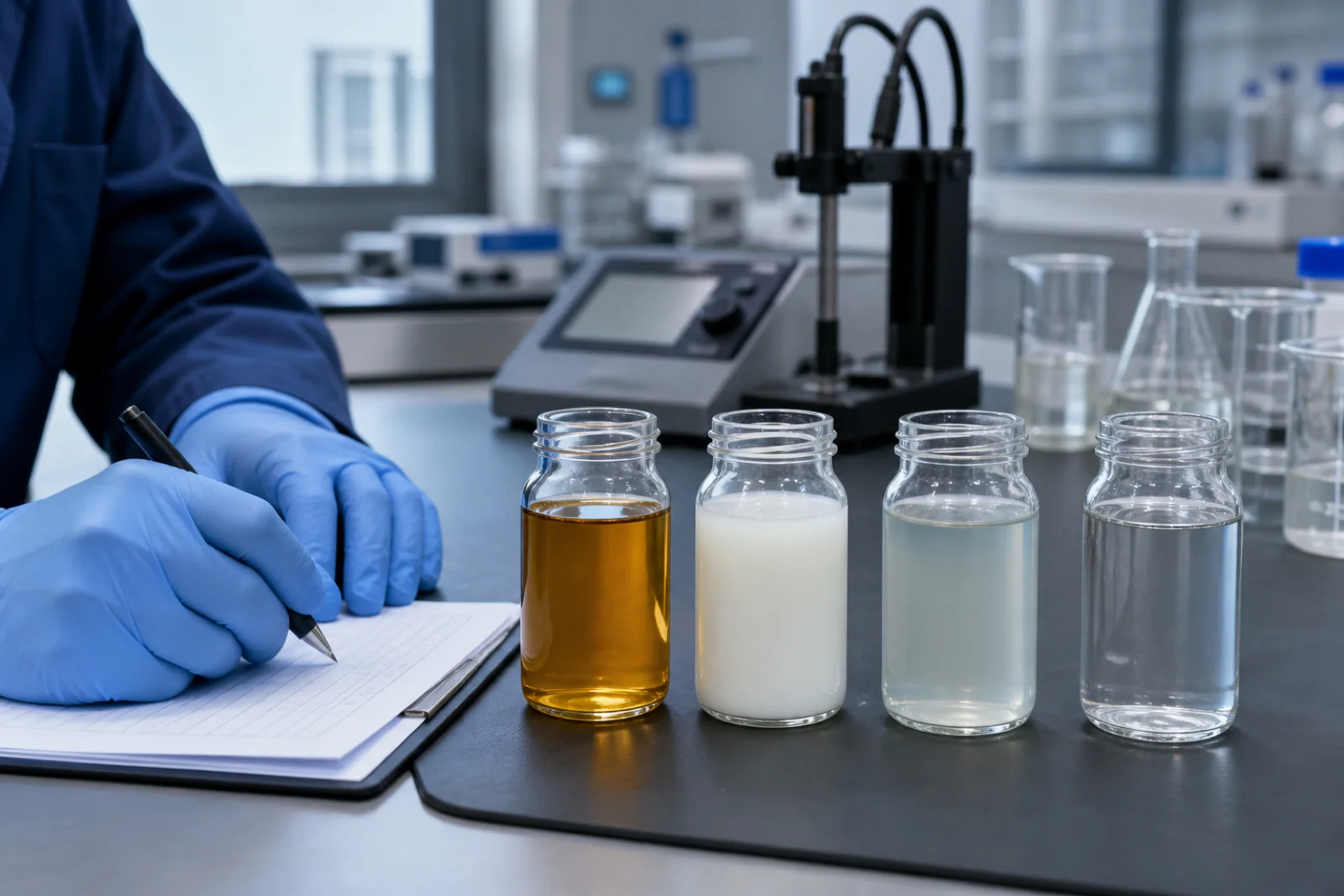
Metalworking fluids: from family selection to field control
Learn why a grinding fluid, severe tapping oil and deep-drawing lubricant solve different physical problems—and how alloy, water, foam, corrosion, residue, filtration and the next production step change the formulation.
All guides
Metalworking Fluid Formulation
A complete guide to neat, soluble, semi-synthetic and synthetic cutting fluids plus grinding, forming, drawing, sump control and field qualification.
ReadBase Oil Groups I–V
API 1509 Groups I to V — saturates, sulfur and viscosity index, mineral vs PAO vs ester, and how to choose a base stock.
ReadSynthetic vs Mineral Oil
What really differs — oxidation, VI, volatility and cost — the Group III "synthetic" debate, and when each makes sense.
ReadSAE Viscosity Grades
What 5W-30 and 15W-40 really mean — the SAE J300 cold-start (CCS/MRV) and hot (KV100/HTHS) limits behind every grade.
ReadAPI Engine Oil Categories
The S (petrol) and C (diesel) series — SP, CK-4 and FA-4 — what each level protects against, and backward compatibility.
ReadACEA Oil Sequences
Europe’s A/B, C and E classes, the SAPS budget behind DPF-safe oils, and how ACEA differs from API.
ReadEngine Oil Technology
How an engine oil works end to end — SAE grades, API/ACEA specs, multigrade behaviour and mineral vs synthetic base oils.
ReadAPI GL Gear Oil Grades
GL-4 vs GL-5 vs MT-1, extreme-pressure additive levels, and the yellow-metal trap of "upgrading" to GL-5.
ReadLube Oil Blending Process
How a formula becomes a finished product — base-oil selection, additive dosing, heated mixing, QC and filling.
ReadLubricant Additives
Every additive family — detergents, dispersants, ZDDP, VII, PPD, antioxidants — what each does and typical treat rates.
ReadGrease Formulation
Thickener chemistries — lithium, complex, calcium sulfonate, polyurea, clay, PFPE — NLGI grades and how to select a grease.
ReadNLGI Grease Grades
What "#2 grease" means — the 000 to 6 consistency scale, the ASTM D217 penetration numbers, and how to pick a grade.
ReadCalcium Grease
Hydrated cup, anhydrous and calcium sulfonate complex — water resistance, temperature limits and where each fits.
ReadFumed Silica Grease
A non-soap, non-melting grease with no dropping point — for extreme heat, chemicals and water. Properties and TDS.
ReadMolybdenum Disulfide (MoS₂) Grease
How the MoS₂ solid lubricant protects under shock and heavy load, typical specs, and where moly grease belongs.
ReadHave a formulation problem these guides don’t solve?
We formulate lubricants, greases and additive packages to your target grade and spec — then prove them in the lab and hand you the IP. Independent R&D since 2010.
Start a consultation →