Metalworking Fluid Formulation —
from the cut to the cleaned component
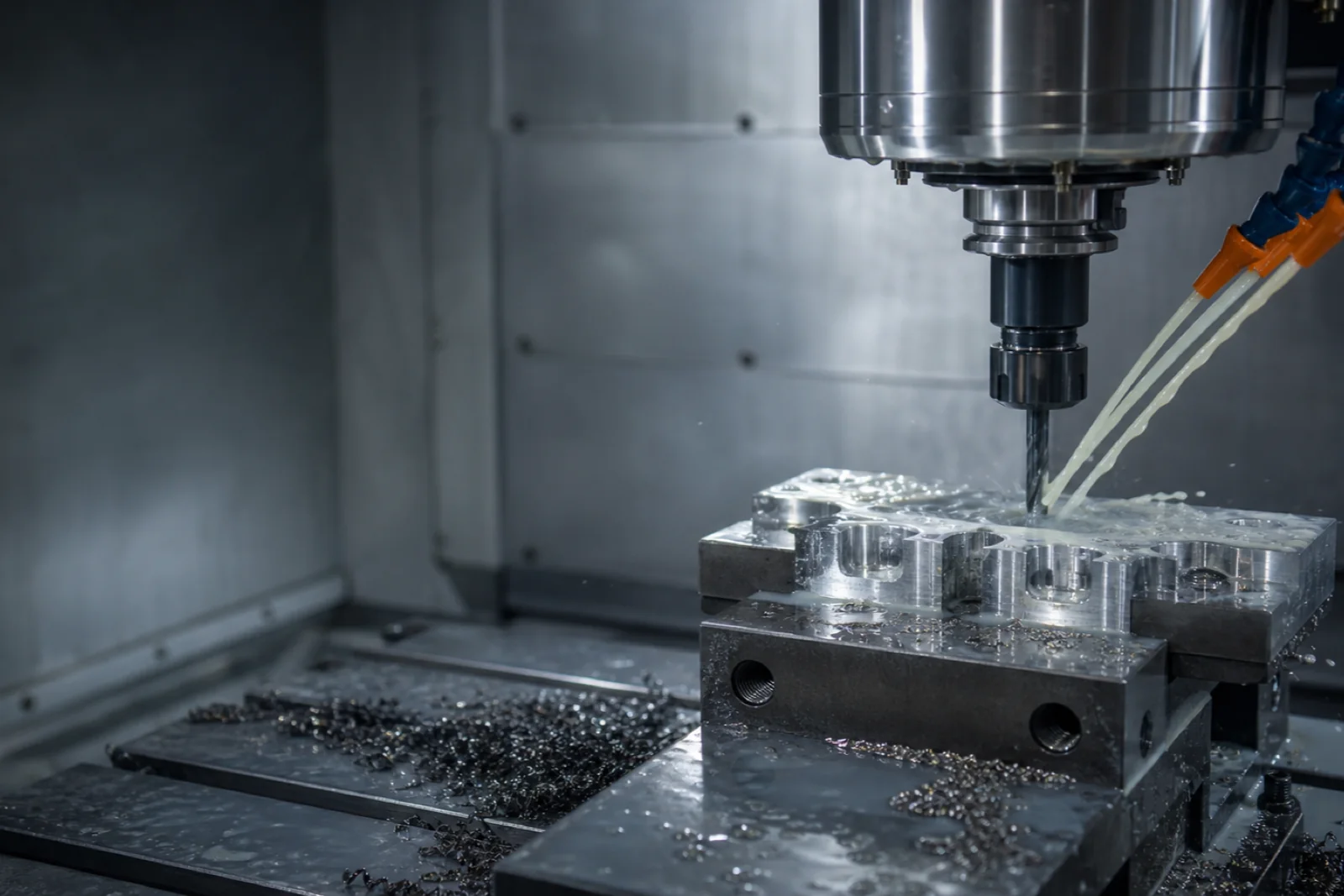
We develop metalworking-fluid systems for cutting, grinding, honing, tapping, broaching, drawing, stamping, rolling, temporary corrosion protection and EDM. The work begins with the operation, alloy, tool, water, machine and downstream process; it does not begin by forcing every application into one soluble-oil recipe. The result is a controlled development package covering fluid-family selection, formulation IP, manufacturing SOP, qualification limits, field-trial design and shop-floor fluid management.
- 01Operation and alloy
- 02Fluid-family selection
- 03Bench-to-field validation
Match the fluid to
the mechanism of work
A useful brief describes how metal is being removed or reshaped, what failure is unacceptable, and what happens to the component next. Cooling matters most in high-speed grinding; boundary lubricity and EP response dominate severe tapping or broaching; aluminium staining, cast-iron corrosion, foam and residue can rule out an otherwise strong system.
Cutting and grinding fluids
Neat, soluble, semi-synthetic and synthetic systems for turning, milling, drilling, tapping, broaching, honing, sawing and grinding.
Forming and drawing lubricants
Oil-based, water-dilutable, evaporative and paste systems for stamping, deep drawing, tube drawing, wire drawing, rolling and cold heading.
Cleaning and temporary protection
In-process cleaners, dewatering fluids and rust preventives designed around the next wash, coating, assembly, storage or shipment stage.
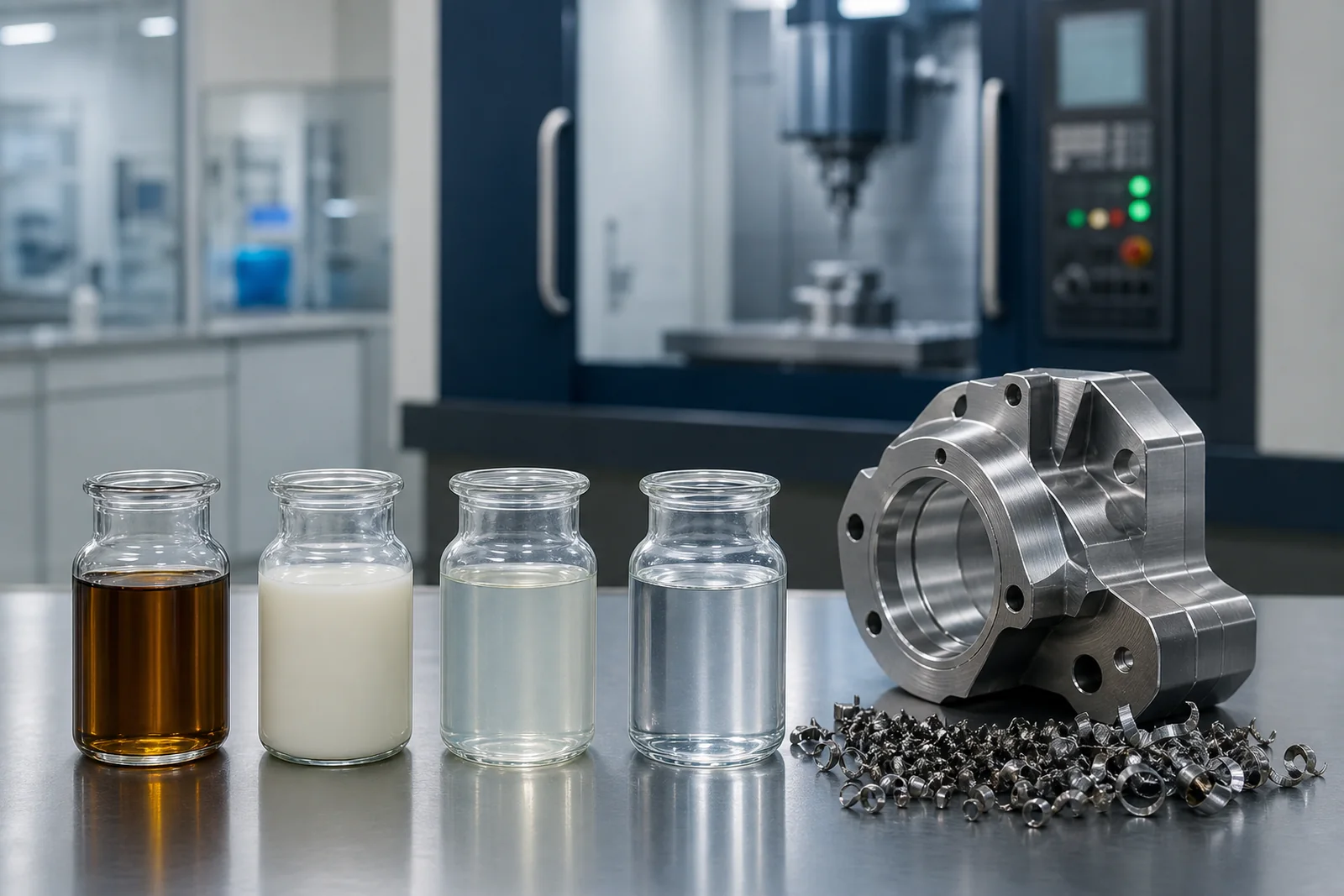
Four removal-fluid families.
More than four product jobs.
Go deeper by fluid family,
process and field problem
Each page follows the same evidence path: operating window, formulation architecture, qualification gates, failure diagnosis and client-owned handover.
What the concentrate
must make possible
| Design block | What it controls | What can go wrong |
|---|---|---|
| Oil or synthetic lubricity carrier | Boundary film, tool life and surface finish | Smoke, residue, staining or insufficient load capacity |
| Emulsifier and hydrotrope system | Dilution behaviour, droplet size and storage stability | Creaming, splitting, hard-water soap or unstable concentrate |
| Corrosion and alkalinity system | Ferrous protection, non-ferrous compatibility and reserve pH | Cast-iron rust, aluminium staining, residue or operator discomfort |
| Foam, microbial and contamination control | Sump life, pumpability, air release and hygiene support | Persistent foam, odour, biomass, blocked filters or short sump life |
Architecture only. Exact ingredients, treat rates, approved uses and suppliers are selected against the client brief, safety data and market regulations, then shared under NDA.
A refractometer does not read concentration directly unless the product-specific factor is known. The field-control band must be established for the actual fluid and water, then checked with pH, appearance, foam, tramp oil and microbial observations rather than relying on one number.
Choose by trade-off,
not by appearance
| Family | Primary strength | Typical constraint | Good starting point when |
|---|---|---|---|
| Neat oil | Boundary lubricity and severe-load protection | Heat removal, smoke, fire and housekeeping | Operation severity dominates cooling |
| Soluble oil | Balanced lubricity and cooling | Emulsion and biological management | General machining spans mixed operations |
| Semi-synthetic | Cooling, visibility and adaptable lubricity | Foam and multimetal balance | Modern CNC cells need one flexible fluid |
| Synthetic | Cooling, cleanliness and fines handling | Boundary load and residue sensitivity | Grinding or light high-speed work dominates |

The same fluid can pass
on steel and fail on aluminium
Cast iron, carbon steel, stainless steel, aluminium alloys, copper and brass challenge different parts of the package. Water hardness and chloride load can change emulsion stability and corrosion behaviour before the fluid even reaches the machine.
Check chip corrosion, flash rust, stained swarf, carry-off film and protection after washing.
Screen staining and darkening across the actual alloy family, temperature and dwell time.
Control copper and brass staining with chemistry selected for the customer’s alloy and process.
Build dilution trials around measured hardness, chloride, conductivity and seasonal variability.
Build a qualification matrix
for the actual application
The values below are example development bands for an initial laboratory screen, not universal sales specifications. The client’s alloy, water, machine, fluid family, intended concentration and customer method define the final limits.
| Property | Test Method | Soluble Target | Semi-Synthetic Target | Synthetic Target |
|---|---|---|---|---|
| Appearance (5% in 200 ppm water) | Visual | Milky white | Translucent | Clear |
| Emulsion pH (5% working) | pH meter | 8.8–9.3 | 9.0–9.5 | 9.0–9.5 |
| Refractive index factor | Brix refractometer | 1.2–1.5 | 1.0–1.2 | 0.8–1.0 |
| Foam (after 5 min stirring, IS 1448 P-67) | Stirring test | <30 ml @ 1 min | <20 ml @ 1 min | <20 ml @ 1 min |
| Corrosion (chip / filter paper test) | IP 287 / IS 1115 | No corrosion 4% | No corrosion 3% | No corrosion 3% |
| Hard water stability (5%, 400 ppm) | Visual | Stable 24 hr | Stable 72 hr | Stable 7 days |
| Tramp oil rejection (5% hydraulic added) | Separation | Separates in 2 hr | Separates in 1 hr | Separates in 30 min |
| Sulphate ash (active sulphur) | D874 | 1.0–3.0% | 0.5–1.5% | <0.5% |
| Falex pin-and-vee EP load | ASTM D2670 | 200–600 lbf | 150–500 lbf | 100–350 lbf |
| Microbial baseline (TVC) | Dip slide | <10³ CFU/ml | <10³ CFU/ml | <10³ CFU/ml |
| Patch corrosion (cast iron) | IP 287 | Pass at 5% | Pass at 4% | Pass at 4% |
Six gates from machine brief
to controlled handover
Operation first.
Then material and machine.
Forming-fluid development
is a system problem
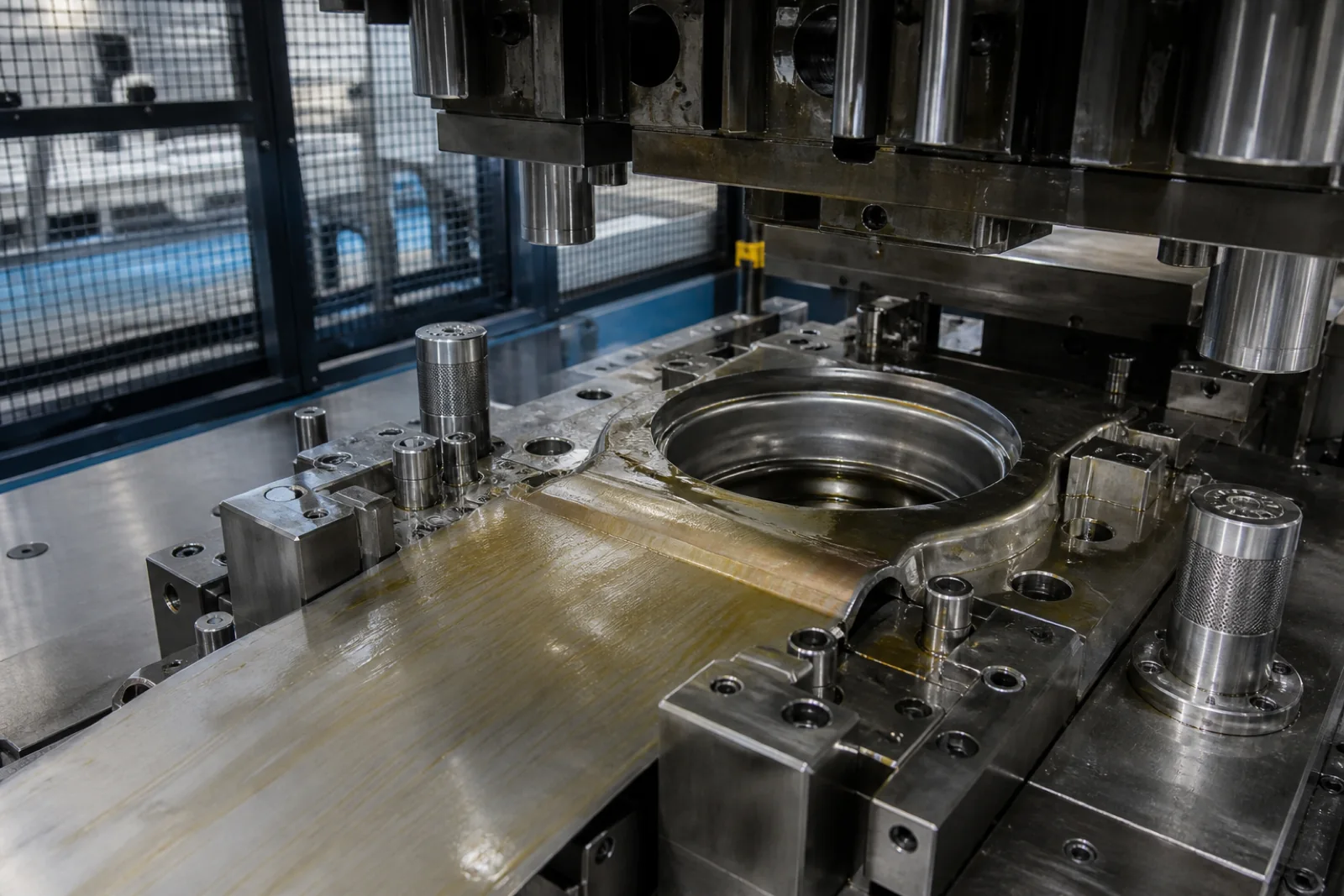
A deep-drawing or stamping lubricant must create a stable film under pressure, help the sheet flow without galling, release from the die and still leave a component that can be washed, welded, coated or assembled. More lubricity is not automatically better if the residue defeats the next process.
Draw ratio, reduction, contact pressure, speed, die geometry and tool material define the film-strength demand.
Roller, spray, dip, brush or recirculation changes viscosity, wetting, carry-off and consumption.
Score, gall, tear, wrinkle, finish and dimensional repeatability become the trial acceptance criteria.
Cleaning, welding, phosphating, painting, plating, bonding and storage set residue and removability limits.
Prove the fluid at four levels.
Do not skip the baseline.
A production and field package,
not a one-page recipe
Formula by weight, functional purpose of each component, approved raw-material grade, primary source and practical alternatives. Exact IP is transferred under the agreed NDA and project terms.
Charge order, mixing conditions, temperature and hold logic, filtration, in-process checks, release sequence and pilot-to-production observations matched to the client’s vessel.
Concentrate, diluted-fluid and application tests with methods, acceptance limits, sample preparation, frequency and responsibility. External laboratory work is identified separately.
Technical-property table, application scope, dilution and make-up guidance, storage, incompatibilities, field-control bands and the ingredient data required for jurisdiction-specific hazard communication.
Baseline, trial machine, part, tool, settings, measurements, review cadence, stop conditions and sign-off. This keeps commercial enthusiasm from replacing a controlled comparison.
First checks for foam, corrosion, staining, odour, instability, residue, short tool life, filter blockage and poor sump life, with clear boundaries for when a laboratory sample is required.
Fluid design does not replace
exposure and sump management
Water-mix fluids can support microbial growth, while machining can create aerosol and repeated skin contact. Enclosure, mist extraction, hygiene, fluid-quality monitoring, cleaning and health surveillance belong to the operating system around the product. Product selection and biocide strategy must follow current supplier labels and the rules of the market where the fluid will be sold and used.
Frequently Asked About
Metalworking Fluid Formulation
Neat oils are used without water. Soluble oils form an oil-rich macro-emulsion in water. Semi-synthetics form a finer micro-emulsion with less oil. Synthetics contain no mineral oil and form a clear or near-clear solution. These are architectures, not a best-to-worst ranking; operation severity, cooling, alloy, water, machine and residue requirements determine the choice.
There is no universal dilution ratio. The product developer sets an application band from corrosion, foam, lubricity, residue and field-trial results. A refractometer reading must be converted with the product-specific factor, and it should be interpreted with pH, appearance, tramp oil and fluid-condition observations.
We test candidate fluids in the actual plant water and in a deliberate hardness range. The emulsifier, hydrotrope and corrosion system is balanced to limit soap formation, instability, residue and loss of ferrous protection. Chloride and conductivity matter alongside hardness, so a complete water report is better than a single hardness value.
Sometimes, but only after mixed-metal screening. Ferrous corrosion, aluminium staining and yellow-metal reactivity respond differently to alkalinity and inhibitor chemistry. We test the actual alloy grades at working concentration and temperature, including realistic dwell and carry-off conditions.
Only from products approved for the intended market and use, at supplier-label conditions and after compatibility testing. The decision also considers concentrate preservation, in-use contamination, pH, temperature, exposure controls and customer restrictions. A biocide is not a substitute for correct make-up, tramp-oil removal, aeration control and sump cleaning.
Common contributors include weak or drifting concentration, contaminated make-up water, stagnant zones, accumulated fines, tramp oil, poor aeration, incompatible cleaner or legacy-fluid residue, and inadequate cleaning before recharge. Diagnosis needs a sample, operating history and machine inspection rather than an automatic biocide top-up.
Yes. The scope includes stamping, deep drawing, tube and wire drawing, rolling, cold forming, in-process cleaners, dewatering fluids and temporary corrosion protection. These projects are qualified against the forming severity and the next operation, especially washing, welding, coating or storage.
The agreed package can include controlled formula and alternatives, manufacturing SOP, raw-material specifications, qualification matrix, COA limits, TDS and SDS inputs, dilution and fluid-management guide, field-trial protocol, scale-up support and IP handover. External laboratory or certification work is identified separately in the proposal.
Build the formulation,
test it and control it in use
Need a Metalworking Fluid
Designed for the actual process?
Share the operation, alloy, machine, tool, plant water, current-fluid TDS and failure or target. We will scope the formulation, qualification and field-trial work needed to reach a production-ready handover.