Home / Metalworking fluids / Cutting Oil Emulsifier Formulation
Soluble oil · Emulsifier system
Cutting Oil Emulsifier Formulation
An emulsifier package makes an oil-rich cutting-fluid concentrate dilute predictably into the customer’s water. It must also coexist with lubricity, corrosion protection, foam control and the actual sump conditions.
ApplicationSoluble cutting-oil concentrate
Fluid systemOil-in-water emulsion
Failure to preventSplit, hard-water soap or foam
Proof routeWater matrix and machine trial
Who this is for
Start with the machine and the customer’s water.
For manufacturers developing or repairing a water-dilutable cutting-oil concentrate. The emulsifier is one part of the finished fluid, not a stand-alone guarantee of machining performance.
A useful brief includes the machining operation, alloys, tool and coolant delivery, make-up water, intended dilution, filtration, current product or sample, and the failure that must improve. Those inputs define the screening plan before ingredients are selected.
Droplet stability without excess dynamic foam
Compatibility with inhibitors and lubricity components
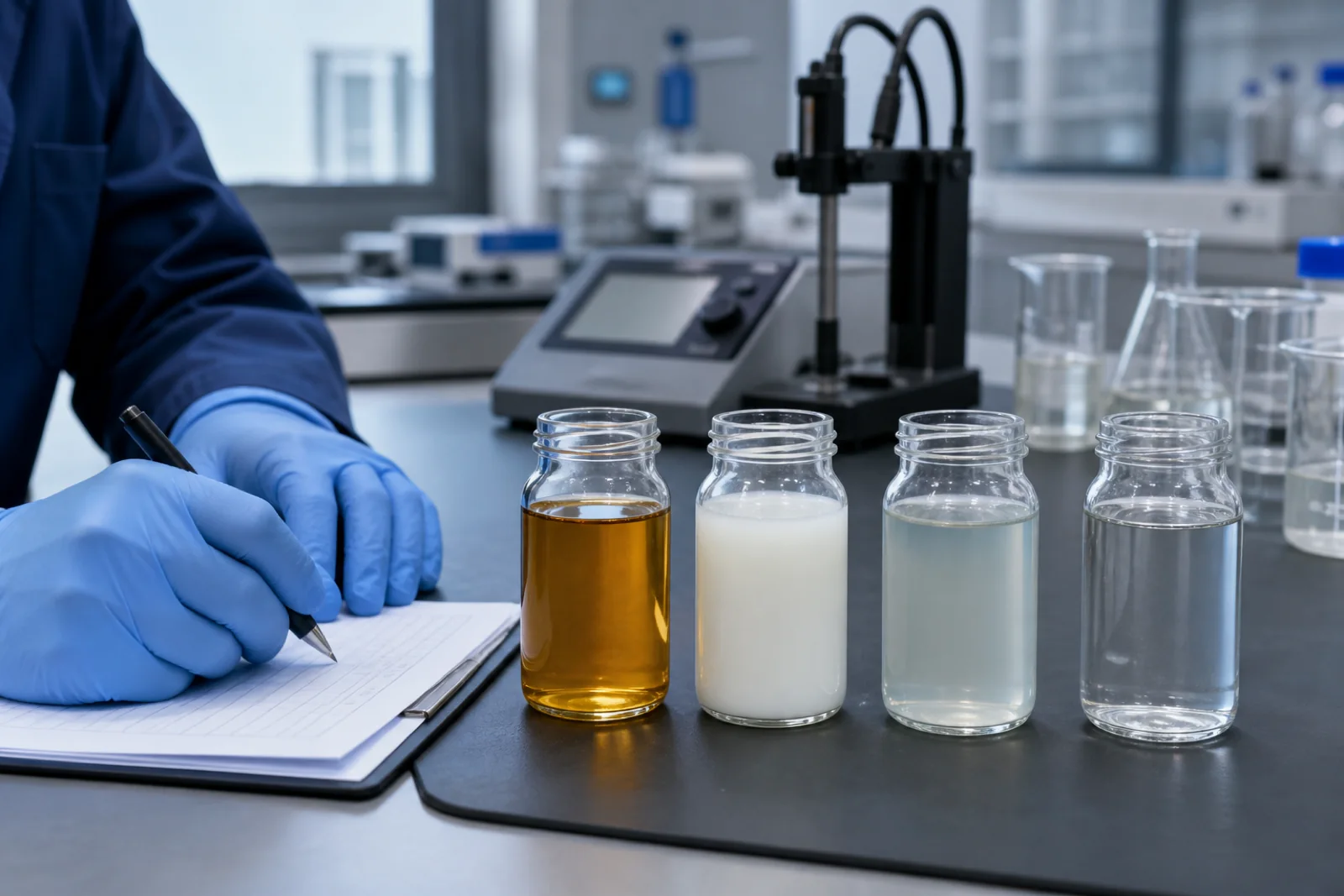
Chemistry decisions
What the emulsifier system has to do
The development question is whether the concentrate mixes reproducibly and stays useful in the customer’s water, machine and alloy mix. Surfactant choice follows that operating window.
Oil phase
Screen the chosen base oil and lubricity components for concentrate compatibility and dilution behaviour.
Interfacial package
Balance primary and supporting emulsifiers for the desired emulsion and tolerance to water salts.
Coupling and foam
Check concentrate clarity or uniformity alongside dynamic foam; a visually stable sample can still fail in a circulating machine.
Whole-fluid compatibility
Recheck corrosion inhibitors, alkalinity, preservation and residue after every emulsifier change.
Fluid-family boundary: Soluble oil normally relies on an emulsifier to disperse an oil phase in water. Semi-synthetic microemulsions need a different balance, while a true oil-free synthetic solution may use wetting agents but has no oil phase to emulsify.
Complete formulation
Balance the whole fluid, not one ingredient.
Oil-phase and surfactant compatibility
Primary and supporting emulsifier balance
Coupling and hard-water tolerance
Low-foam and corrosion-support integration
Project handover: A scoped engagement can provide a client-owned formulation, raw-material list, manufacturing method, QC limits and trial plan. Exact ingredients, proportions and blend order are determined and released only after compatibility, safety and performance review.
Qualification sequence
Prove concentrate, dilution and cutting performance.
Candidates advance from bench screening to a controlled machine trial only when the relevant failure risks have measurable acceptance criteria. The final limits belong to the customer’s materials and process.
- Concentrate cold and heat stability
- Concentrate-into-water dilution series in soft, actual plant and harder challenge waters
- Creaming, separation and hard-water deposit observations
- Recirculation foam and air-release behaviour
- Multi-metal corrosion, residue and controlled sump ageing
When a trial fails
Separate formula, water and machine effects.
Creaming or oil split → compare water quality, dilution order and surfactant balance
Hard-water soap → challenge calcium and magnesium levels
Foam → test under real return flow and pump aeration
Rust or stain → review the whole inhibitor and pH system
For a failed field trial, retain a clean concentrate, fresh dilution, sump sample and make-up-water sample. Record concentration, age and machine conditions before changing the package.
Common selection questions
Answers before a development brief.
Can one emulsifier package work with every cutting oil?
No. Oil polarity, lubricity additives, water hardness, metals and machine aeration change the required balance. We qualify the package inside the complete concentrate.
Is a clear concentrate proof of a stable coolant?
No. Dilution stability, deposits, foam, corrosion and aged-sump behaviour must be checked separately.
What do you need to start?
A base-oil and additive list or current sample, target dilution, plant-water report, alloys, operations and details of any splitting, foam or rust.
General category and safe-use background: OSHA metalworking-fluids manual and HSE metalworking-fluid guidance. These references do not certify any proposed formulation.
Published industry references
Use supplier guidance to sharpen the test brief.
The sources below are examples from established fluid and additive suppliers, reviewed on 30 September 2026. They inform questions and test design; their product claims and limits are not results for a Lubechem formulation.
Metalworking-fluid components
BASF distinguishes nonionic emulsifiers, coupling agents and solubilisers, and describes low foam and hard-water stability as separate formulation properties.
Our check: Screen concentrate compatibility, water tolerance and dynamic foam independently.
Metalworking additives portfolio
Stepan describes emulsifiers alongside coupling, corrosion and lubricity functions in soluble and semi-synthetic fluids.
Our check: Recheck the whole fluid when one multifunctional ingredient changes.
Emulsifier selection guide
Clariant compares nonionic and anionic emulsifier roles, including oil solubility, hard-water stability and low-foam behaviour.
Our check: Compare surfactant families against the actual oil phase and water matrix.
Related technical pages