Home / Metalworking fluids / Metalworking Fluid Troubleshooting
Failure analysis · Root cause

Metalworking Fluid Troubleshooting

Most failures have several plausible causes across chemistry, water, machine, contamination and operating practice. A disciplined fault tree prevents expensive trial-and-error dosing.

OperationActive production failure
Fluid familyAny metalworking-fluid family
Failure riskRepeated dosing without root cause
Proof methodSample set, fault tree, controlled correction
Formulation target

Define the operating window before selecting chemistry.

The development brief records operation severity, workpiece and tool materials, machine delivery, water or carrier constraints, filtration, downstream processing and the failure that the new product must prevent.

01

Define when and where the symptom occurs

Converted into a measurable screening or field-trial gate.
02

Separate formulation from system and practice

Converted into a measurable screening or field-trial gate.

03

Test one corrective hypothesis at a time

Converted into a measurable screening or field-trial gate.

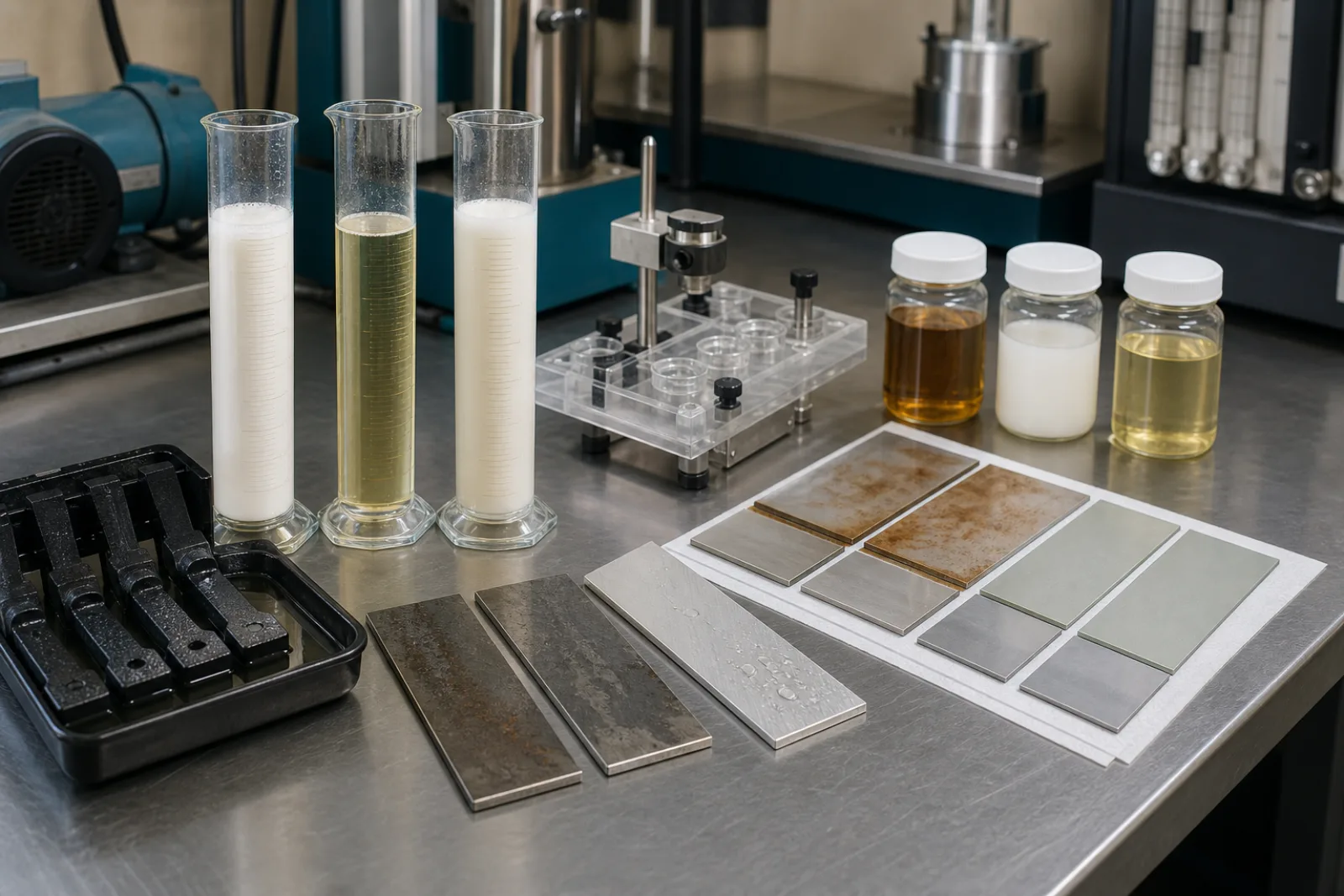
Laboratory comparison of metalworking-fluid samples and corrosion test coupons
Preserve a clean concentrate, fresh dilution, live sump and water sample so the failure can be separated into product, process and contamination causes.
Formulation architecture

Build a balanced system, then challenge its weak points.

Raw-material choices are made against the brief, regulatory constraints and available supply routes. Exact components and treat rates remain part of the client-owned development package.

Fluid foundation

Timeline, machine and batch evidence collection

Performance system

Clean-versus-field sample comparison

Compatibility control

Water, contamination and materials review

Stability support

Bounded corrective trial with rollback point

Responsible boundary: this page describes selection logic and evidence gates, not a production recipe. Final composition depends on the client’s raw materials, equipment, safety review, compliance duties and validated trial results.
Qualification gates

Connect each test to a release decision.

A useful programme begins with a baseline, identifies technical risks, screens candidates with appropriate methods and ends with a controlled field trial.

  1. Concentration, pH, appearance and odour record
  2. Water hardness, salts and microbial indicators
  3. Tramp oil, cleaner and hydraulic leakage check
  4. Machine flow, pressure, temperature and aeration
  5. Post-correction finish, corrosion and tool-life confirmation
Failure map

Diagnose product, process and contamination together.

Foam → air ingress, cleanliness and surfactancy path
Rust → concentration, water, carry-off and inhibitor path
Stain → alloy, cleaner, pH and active chemistry path
Poor tool life → delivery, tool, speed and lubricity path
Development handover

What the engagement can produce.

01

Technical brief & risk matrix

Target duties, materials, constraints, acceptance criteria and test plan.

02

Qualified formulation package

Client-owned formula, BOM, manufacturing method and in-process controls.

03

QC specification

Raw-material checks, finished-product limits, sampling and release records.

04

Trial & operating guide

Commissioning, monitoring, corrective actions and change-control notes.

05

Safety and compliance inputs

Data needed for the client’s SDS, label, exposure and market review.

06

Supplier alternatives

Functionally qualified options where substitution risk can be controlled.